


Mercredi 21 mai 2014
If you’ve been imagining NSA surveillance as something distant, with
analysts sitting in remote data centers quietly analyzing metadata—stop
now. NSA surveillance has become a part of day-to-day law enforcement
fabric in the United States. The Snowden disclosures that were made public as part of Glenn Greenwald’s book No Place to Hide drive this point home, and they emphasize why we need real change to government surveillance, not minor reforms.
There are two key points necessary to understand the domestic aspect of NSA surveillance: the integral role of the FBI in helping the NSA
spy on Americans, and the acceptance of usage of NSA material for
domestic and traditional law enforcement purposes. These are contingent,
of course, on the fact that the NSA’s procedures allow widespread targeting of Americans.
Much of the material published on May 13 expanded on the disturbing
revelations that we’ve already seen, but there were some standout
points: new information about the degree of spying on the U.N. and other
foreign officials, documents demonstrating the economic espionage
aspect of NSA surveillance, and some interesting technical details about
NSA programs. Among those technical details, what was especially
striking for those of us in the United States were the slides that
described how the FBI enables NSA surveillance.
A series of slides demonstrated that the FBI essentially serves as an
attack dog for the NSA, doing the NSA’s domestic dirty work. One slide,
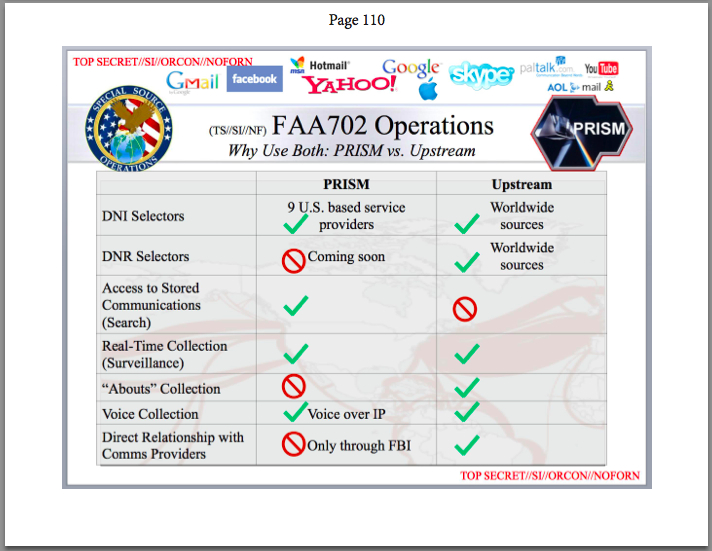
which was previously published, notes that for purposes of PRISM,
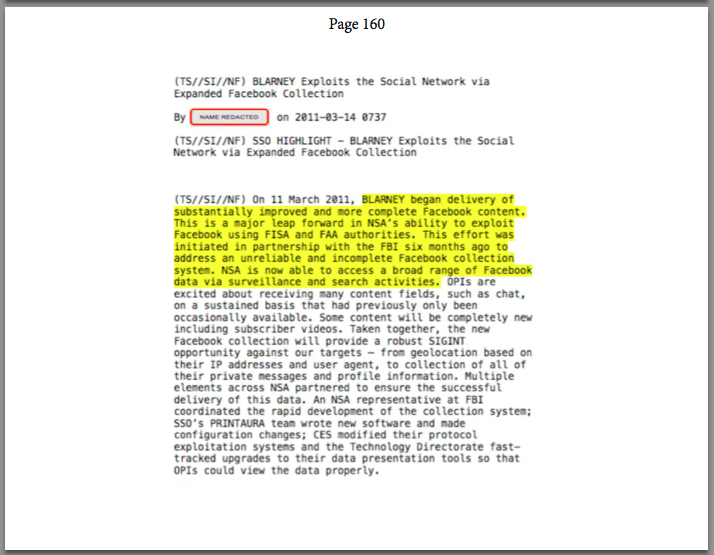
relationships with communications providers are only through the FBI. ( slide23.jpg). Another slide describes how the FBI and NSA partner to “address an unreliable and incomplete Facebook collection system.” (slide81.jpg).
slide23.jpg). Another slide describes how the FBI and NSA partner to “address an unreliable and incomplete Facebook collection system.” (slide81.jpg).
There are also a series of slides describing the FBI’s relationship
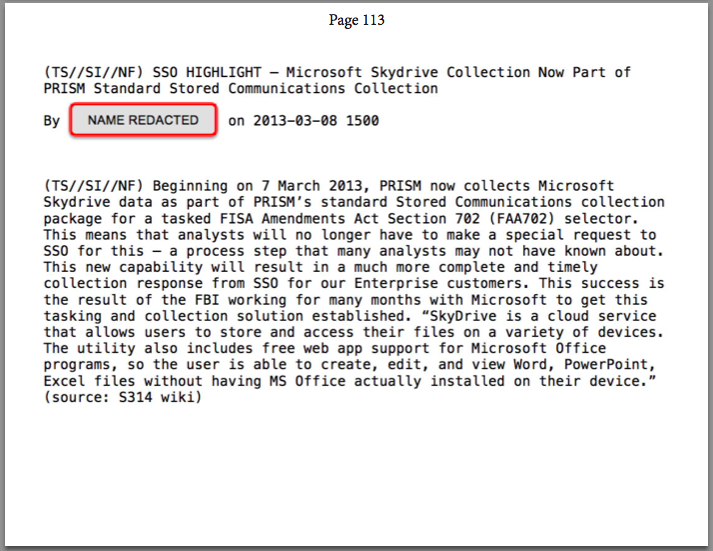
with Microsoft. One notes that the NSA is now able to collect Microsoft
Skydrive data as a “result of the FBI working for many months with
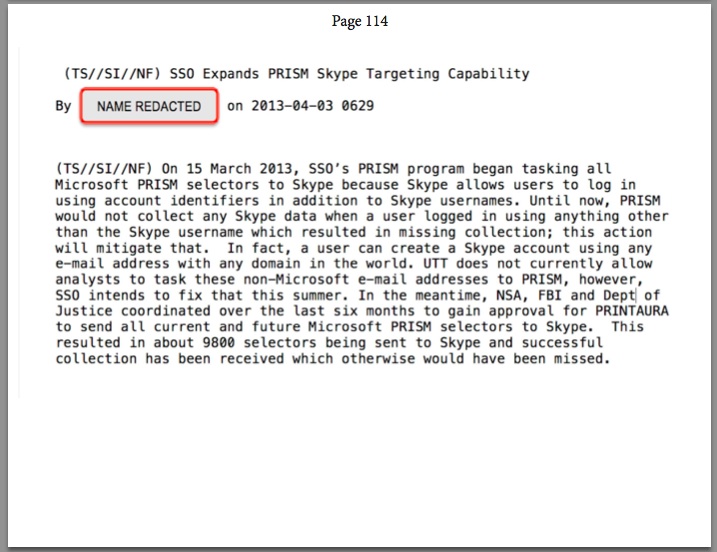
Microsoft to get this tasking and collection solution established .” (slide27.jpg). The documents also show that the NSA, Department of Justice, and FBI collaborated to collect Skype data. (slide29.jpg).
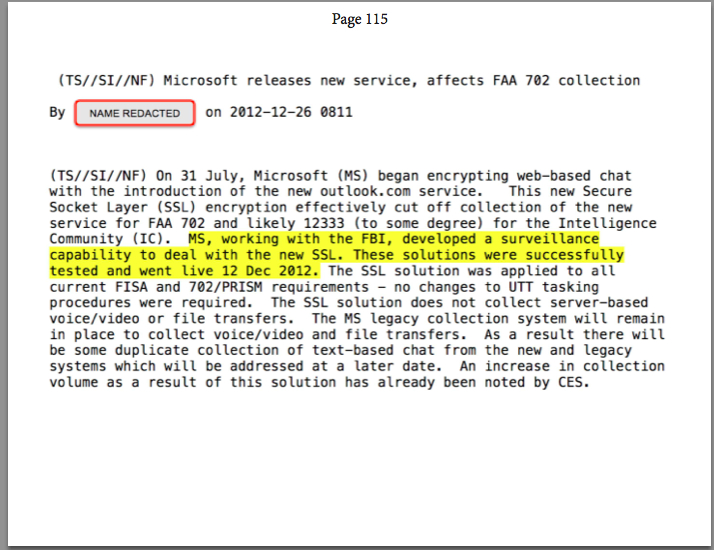
Similarly, after Microsoft enabled encrypted chat: “MS, working with
the FBI, developed a surveillance capability to deal with the new SSL.” (slide30.jpg).
slide27.jpg). The documents also show that the NSA, Department of Justice, and FBI collaborated to collect Skype data. (slide29.jpg).
Similarly, after Microsoft enabled encrypted chat: “MS, working with
the FBI, developed a surveillance capability to deal with the new SSL.” (slide30.jpg).
Clearly, the NSA would have a much more difficult—if not impossible—time collecting information without the FBI.
None of this should be surprising. It's easy to forget that Section
215 of the Patriot Act allows the Federal Bureau of Investigation—not the NSA—to apply for production of business records. Remember the Verizon order
that jumpstarted the NSA surveillance conversation? That order was an
application to the Foreign Intelligence Surveillance Court by the FBI for production of Verizon’s business records to the NSA.
The national discourse since June 6, 2013, has been about NSA spying.
But talking about NSA spying on its own doesn’t make sense. We need to
be talking about the surveillance state as a whole.
And it’s not just the FBI that we should be concerned about. The
NSA’s role in ordinary investigations is not new information. But every
document that expands on the NSA’s involvement in anything domestic, and
not national security related, should ring alarm bells for everyone in
the United States. We know now that:
- The NSA data is fed to the Drug Enforcement Agency’s “Special Operations Division.” The DEA in turn uses this information in ordinary investigations, while cloaking the source– even from judges and prosecutors.
- The Foreign Intelligence Surveillance Court authorized the NSA to share unminimized data with the FBI, as well as the CIA, with the “Raw Take” order. Prior to this “agencies [had] to 'minimize' private information about Americans — deleting data that is irrelevant for intelligence purposes before providing it to others.”
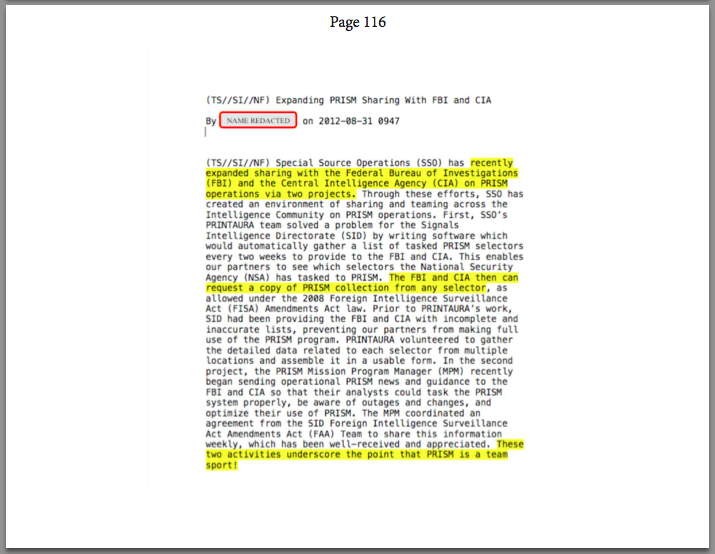
- Information sharing between the FBI, NSA, and CIA has been
routinized through “software which would automatically gather a list of
tasked PRISM selectors every two weeks to provide to the FBI and CIA.” (slide31.jpg).
Similarly, the NSA sends “operational PRISM news and guidance to the
FBI and CIA so that their analysts could task the PRISM system properly,
be aware of outages and changes, and optimize their use of PRISM.”
- And, most recently, we learned that the NSA partners with the DEA to record nearly all cell phone calls in the Bahamas– but not for national security purposes. This surveillance helps “to locate ‘international narcotics traffickers and special-interest alien smugglers’—traditional law-enforcement concerns, but a far cry from derailing terror plots or intercepting weapons of mass destruction.” In fact, a 2004 memo discusses the NSA’s integral role in the war on drugs.
Everything we now know about the NSA paints a picture of an
agency that has grown wildly outside the bounds of its purpose—to
protect national security. The national security justifications for
dragnet surveillance ring hollow. It’s time to take Congress and the President to task for this, and call for an end to the unchecked actions of our dangerous spy agencies—the NSA and the FBI.


Aucun commentaire:
Enregistrer un commentaire